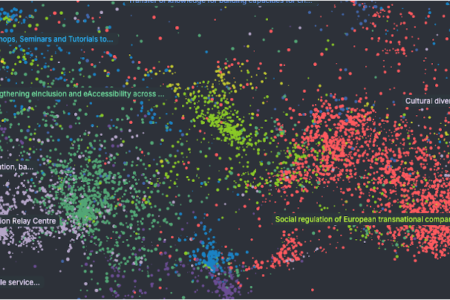
Science & Society The global map of science according to EU funding In this blog post, we report a global funding landscape created using semantic relations of all EU R&I Framework Programme grants that helps locate regions, organisations and funders in the disciplinary space of science without relying on citation data. Adrià Plazas + 5 others • 04-03-2026
Science & Society Analysing research funding flows in the Global South In a context marked by deep asymmetries in access to research resources, the research project “Tracking Research Funding Flows in the Global South” aims to make visible and analyze the ways in which international funding for science circulates. Matías Alcántara + 4 others • 22-07-2025
Science & Society The contested field of Open Science: a debate through the lens of inclusion Most implementations of Open Science do not fulfil the expectations that Open Science will lead to more equity and improve the societal impact of research. We discuss these worrying trends through the lens of inclusion. Fernanda Beigel + 1 other • 08-05-2025
Science & Society Interrogating and Monitoring Equitable Open Science The development of Open Science (OS) is raising difficult questions about its implications for equity and inclusion. In this blog post, we report the insights gained from four sessions at the EASST/4S conference in July 2024, particularly in relation to OS monitoring. Louise Bezuidenhout + 4 others • 04-11-2024
Science & Society Not only Open, but also Diverse and Inclusive: Towards Decentralised and Federated Research Information Sources The Barcelona Declaration on Open Research Information highlights that research information systems should not only be open but also diverse and inclusive. We argue that this can only be achieved by interlinking various and decentralised research information sources. Dominique Babini + 5 others • 22-04-2024
Science & Society Concurrent Evidence: a framework for using evidence from multiple disciplines In policy and legal systems, focusing too narrowly on one scientific discipline can lead to questionable conclusions. In this post, Tsuyoshi Hondou and Ismael Rafols introduce ‘Concurrent evidence’, a framework that considers evidence from multiple disciplines to reach more robust decisions. Tsuyoshi Hondou + 1 other • 07-03-2024
Opinion & Commentary The UNESCO Open Science Outlook: OS progresses, but unequally Last December, UNESCO published the first global report on the trends of Open Science (OS). In this blog post, the main findings are highlighted: OS is increasing but does so unevenly and its monitoring is mainly focused on outputs, missing potential progress in participation and dialogue. Ismael Rafols • 01-02-2024
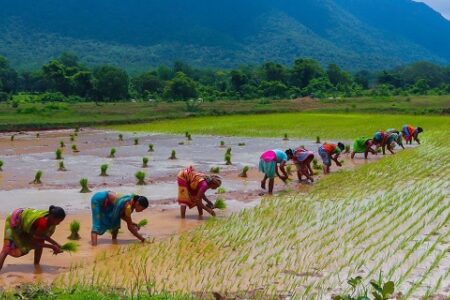
Long-read · Science & Society Why coverage matters: Invisibility of agricultural research from the Global South may be an obstacle to development To support development and sustainability in the Global South, contextual and locally appropriate knowledge on agriculture needs to be visible and accessible. Improving coverage in global open scholarly infrastructures can play a crucial role in increasing visibility. Ismael Rafols + 4 others • 21-07-2023
Science & Society Why are diversity and inclusion important for Global Science? CWTS is starting a new UNESCO Chair on Diversity and Inclusion in Global Science. In this blog post we outline why this topic matters and how our team aims to contribute to UNESCO's agenda of making science a positive force for development. Ismael Rafols + 2 others • 10-11-2022